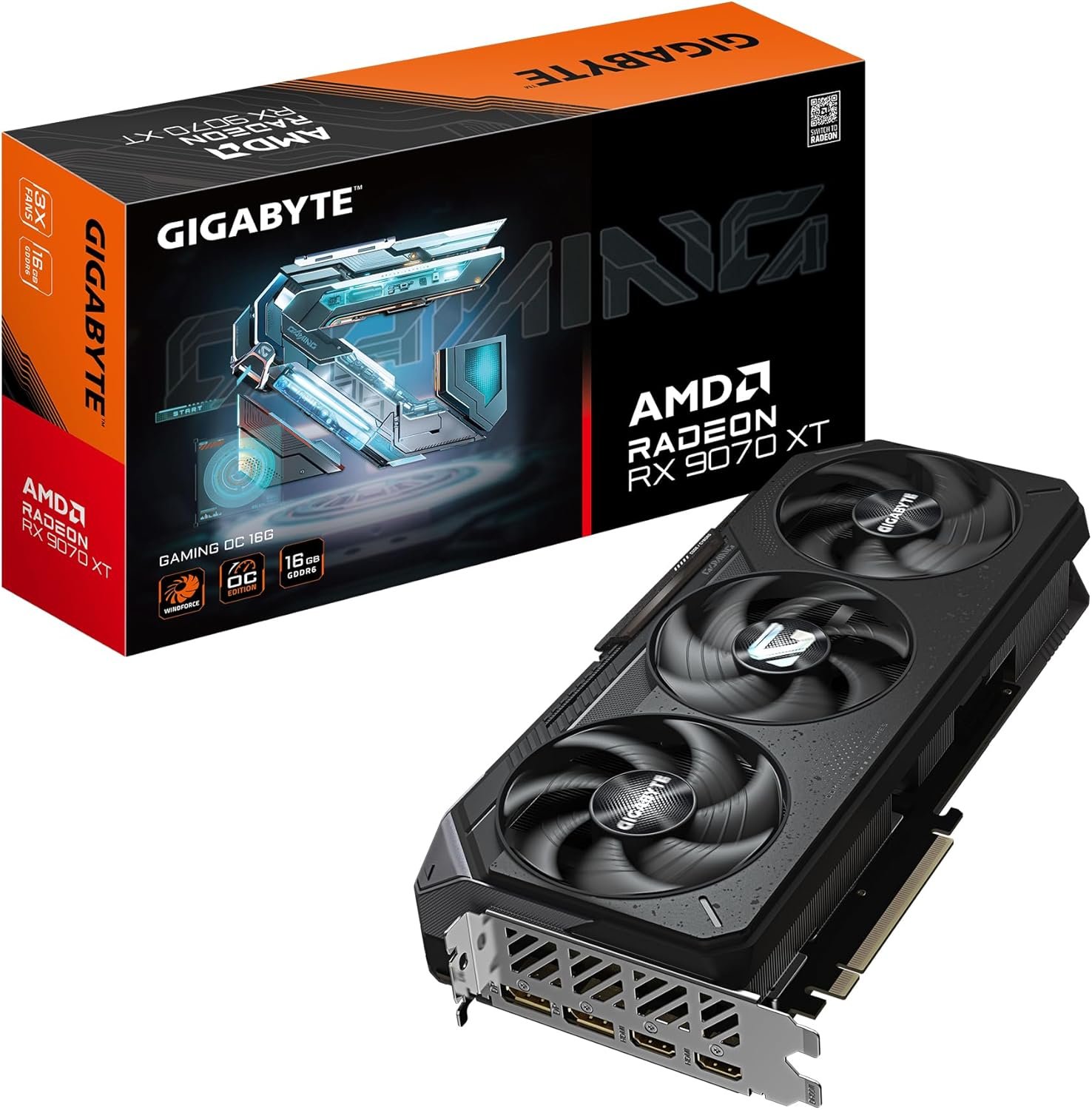
GIGABYTE Radeon RX 9070 XT Gaming OC 16G Graphics Card
Next-Gen GPU Deep Dive
The High-Bandwidth Vanguard: GIGABYTE Radeon RX 9070 XT Gaming OC Review
The release of AMD’s RDNA 4.0 architecture marks a substantial evolution in mainstream and high-end graphics processing. Moving beyond pure rasterization metrics, the GIGABYTE Radeon RX 9070 XT Gaming OC 16G establishes its position by optimizing dedicated hardware resources for real-time ray tracing and artificial intelligence pipelines. Built for the modern PCIe 5.0 interface, this card pairs massive bandwidth with an optimized, triple-fan cooling system designed to manage sustained processing loads with minimal acoustic output.

For visual professionals, dedicated PC gamers, and system builders who require sustained, unthrottled frame rates on ultra-wide panels, standard reference boards often force a compromise between thermals and physical case space.
Housed in a matte black, structurally reinforced chassis, the GIGABYTE RX 9070 XT Gaming OC circumvents these traditional design flaws. By introducing a massive triple-slot cooling layout and direct-contact copper heat pipes, the card maintains structural rigidity and cool operating parameters under demanding 4K workloads.
Architectural Blueprint: RDNA 4.0 & Navi 48 Silicon
Underneath the robust matte-black shroud lies AMD’s Navi 48 XTX graphics processor, fabricated on TSMC’s advanced 4-nanometer node. The physical layout incorporates 4,096 shading units alongside a highly evolved cache structure designed to mitigate long-standing memory latency issues. A major architectural leap within RDNA 4.0 is the integration of 3rd-generation Ray Tracing cores and dedicated Matrix Cores for machine learning. These elements allow the GPU to calculate complex light bounces and handle AI upscaling natively on-chip, reducing the overall computational tax placed on the primary shading units.
Operating at a bolstered factory boost clock of up to 3060 MHz, this custom GIGABYTE edition pushes significantly past AMD’s reference guidelines. To feed this high-frequency compute die, the board features 16GB of dedicated GDDR6 memory utilizing a wide 256-bit bus, achieving a staggering bandwidth of 644.6 GB/s. While some extreme-tier competitors have transitioned to GDDR7 or GDDR6X memory architectures, GIGABYTE’s integration of highly stable GDDR6 on a wide bus ensures excellent thermal stability and reliable, long-term memory operations without the extreme heat density associated with higher-voltage memory standards.


Windforce 3X System
Utilizes three 80mm alternate-spinning Hawk fans paired with composite copper heat pipes. This mechanical layout actively eliminates turbulence and accelerates heat dispersion across the dense fins.
PCIe 5.0 Interface
The transition to the ultra-fast PCI-Express 5.0 x16 interface ensures maximum platform bandwidth, future-proofing your desktop for high-throughput memory streaming and next-gen NVMe platforms.
Server-Grade Thermal Gel
GIGABYTE implements premium server-grade thermal paste on the GPU die, drastically lowering thermal resistance and completely preventing the “pump-out” degradation common over multi-year cycles.
Advanced Thermodynamics & Structural Rigidity
Sustaining high GPU core frequencies requires highly optimized thermal engineering. The Windforce cooling system on this model utilizes alternate-spinning fan mechanics—the center fan spins counterclockwise, while the outer two spin clockwise. This deliberate design reduces the aerodynamic friction that occurs where the air columns meet, creating a highly unified column of downward air pressure. Direct-contact copper heat pipes sit squarely against the silicon die and the surrounding GDDR6 modules, ensuring that thermal energy is transferred directly into the aluminum heatsink with minimal travel delay.
Structurally, GIGABYTE has fortified the RX 9070 XT with a thick, protective metal backplate. This backplate is not merely decorative; it provides essential structural support, preventing the “PCB sag” that can damage modern PCIe slots over long-term usage. Additionally, the backplate features a generous pass-through ventilation cutout near the rear, allowing excess hot air to flow directly through the card and toward the case exhaust fans, significantly reducing localized heat pockets around the motherboard’s main components.
Technical Specifications Matrix
| Graphics Architecture | AMD RDNA 4.0 (Navi 48 XTX) |
|---|---|
| Stream Processors | 4096 Shading Cores |
| Ray Tracing / Matrix Cores | 64 Raytracing Cores (3rd Gen) / 128 Matrix Cores |
| Boost Core Clock Speed | Up to 3060 MHz (Reference: 2970 MHz) |
| Dedicated Video Memory | 16GB GDDR6 (256-bit Bus, 20 Gbps Effective) |
| Wired Bus Interface | PCI Express 5.0 x16 |
| Dimensions & Slot Width | L=288 W=132 H=56 mm (Triple Slot) |
| Power Interface & Recommended PSU | 3x 8-pin Power Connectors (850W PSU Recommended) |
| Visual Port Layout | 2x DisplayPort 2.1a, 2x HDMI 2.1b (Max Resolution: 7680×4320) |
Product Evaluation: Pros & Considerations
Pros
- Outrageously high 1440p and native 4K rasterization framerates in AAA titles.
- Generous 16GB VRAM buffer ensures complete future-proofing against texture memory limits.
- Advanced Windforce alternate-spinning fans offer stellar, silent acoustics under full load.
- The PCIe 5.0 interface maximizes motherboard platform throughput for modern systems.
Consider Alternatives If
- Your case cannot accommodate a large triple-slot (56mm thickness) layout.
- You prefer newer high-voltage memory standards like GDDR7 or GDDR6X.
- Your current power supply lacks the necessary three independent 8-pin connectors.
- Your workload demands absolute top-tier, path-traced ray tracing in specialized software.
Frequently Asked Questions
What are the specific benefits of the alternate-spinning fan layout?
In traditional triple-fan layouts, adjacent fans spin in the same direction, creating counter-directional turbulence where the air columns meet. GIGABYTE’s alternate-spinning design has the middle fan rotating in the opposite direction. This aligns the airflow vectors at the boundaries, drastically reducing turbulence, streamlining the intake column, and lowering overall system noise.
Does this card require a PCIe 5.0 motherboard to function?
No, the PCI Express 5.0 interface is fully backward compatible. You can easily install the RX 9070 XT on a PCIe 4.0 or PCIe 3.0 motherboard. However, utilizing a modern PCIe 5.0-enabled platform (such as AM5 or Intel LGA1700/1851 with Gen 5 support) ensures you unlock the maximum theoretical bus speeds of the card.
Why does the Gaming OC edition feature three 8-pin power connectors?
To maintain the elevated factory overclock of 3060 MHz stably over prolonged durations, the card requires stable power input. The triple 8-pin layout distributes the high load evenly across multiple cables, preventing localized heat build-up on individual wires and ensuring consistent voltage delivery under heavy overclocked gaming scenarios.
This post contains affiliate links. #CommissionsEarned
As an Amazon Associate, I earn from qualifying purchases. This expert editorial review is based on an objective analysis of technical specifications and aggregated consumer feedback. I have not been compensated by the manufacturer to publish this review. Product prices, hardware configurations, and availability are managed directly by Amazon US and are subject to change without notice.